Note
Click here to download the full example code
Find and fix degenerate solids
A solid that arrives from another program or from hand editing can look whole on screen and still be broken:
a hole a few triangles wide, a patch wound inside out, a stray triangle hanging off an edge. Inside tests and
volumes need a closed, consistently wound solid. You damage a clean solid in five typical ways, find each defect
with Mesh.validate, repair what Mesh.repair can, fix the rest by hand, and check the result against the
original.
import sys
from pathlib import Path

HERE = Path(__file__).parent if "__file__" in globals() else Path.cwd()
sys.path.insert(0, str(HERE.parents[1]))
import boitata as bt
import matplotlib.pyplot as plt
import numpy as np
from common import ACCENT, GRAY, HIGHLIGHT, INK, LIGHT, save
What you'll learn
- What makes a triangle mesh a valid solid, and the defects that break it.
- How to read the
MeshReportfromMesh.validate: a summary of counts and one row per problem. - What
Mesh.repairfixes, and how to fix a hole or a stray triangle it leaves. - Why a closed mesh can still give a wrong volume.
Prerequisites: solids and mesh files, which repairs a mesh read as loose triangles.
The problem
A solid is a closed surface: every edge is shared by exactly two triangles, and every triangle is wound the same way, counter-clockwise seen from outside. Inside tests and volumes rely on both.
Mesh.validate reports. A boundary edge belongs to one triangle
(a hole); a non-manifold edge to three or more (a fin); an inconsistent edge is run the same way by its two
triangles (a flipped face); a degenerate face has no area; a duplicate face repeats the corners of another.The data
Lens 2 of the stacked sulphide lenses is a clean solid. validate returns a MeshReport: its summary counts
each kind of problem.
data = bt.datasets.stacked_sulphide_lenses()
lens = data["lens_2"]
report = lens.validate()
print(lens, report)
print(f"volume {lens.volume:,.0f} m3")
Out:
Mesh(12962 vertices, 25920 triangles, closed) MeshReport(0 problems, 1 shells, closed)
volume 1,901,081 m3
Five defects go in at five places, each a common way a solid gets broken:
- a patch of triangles within 80 m of one point is wound the other way, as when a surface is joined back in reversed;
- the triangles within 12 m of the lowest point are deleted, a hole;
- three triangles are repeated, as when two exports of the same surface are merged;
- one triangle gets a repeated corner, a sliver with no area;
- a triangle is added on an edge near the top, a fin sticking out, as a stray digitized point makes.
vertices, triangles = lens.coords, lens.triangles
centers = vertices[triangles].mean(axis=1)


def near(point, radius):
    return np.linalg.norm(centers - point, axis=1) < radius


flipped = near(centers.mean(axis=0) + [0, 0, 60], 80)
hole = near(centers[centers[:, 2].argmin()], 12)
damaged = triangles.copy()
damaged[flipped] = damaged[flipped, ::-1]
damaged = damaged[~hole]
top = damaged[centers[~hole][:, 2].argmax()]
fin_tip = vertices[top[:2]].mean(axis=0) + [0, 0, 25]
damaged = np.vstack(
    [
        damaged,
        damaged[[4000, 4001, 4002]],
        [damaged[8000, [0, 0, 1]]],
        [[top[0], top[1], len(vertices)]],
    ]
)
broken = bt.Mesh(np.vstack([vertices, fin_tip]), damaged)
print(f"{flipped.sum()} triangles flipped, {hole.sum()} deleted")
print(broken)
Out:
2235 triangles flipped, 38 deleted
Mesh(12963 vertices, 25887 triangles, open, 26 boundary edges)
Why it matters
The broken solid is open, so volume and contains raise an error:
for name, call in [("volume", lambda: broken.volume), ("contains", lambda: broken.contains(centers[:1]))]:
    try:
        call()
    except ValueError as error:
        print(f"{name}: {error}")
Out:
volume: invalid geometry: volume needs a closed mesh
contains: mesh is not closed; this needs a solid
The flipped patch alone leaves the mesh closed, so neither call raises. Its volume is wrong, and so is the inside test near the patch. Twenty thousand random points in the lens's bounding box show it:
only_flipped = triangles.copy()
only_flipped[flipped] = only_flipped[flipped, ::-1]
closed_but_wrong = bt.Mesh(vertices, only_flipped)
rng = np.random.default_rng(0)
low, high = np.array(lens.bounds)
points = low + rng.random((20_000, 3)) * (high - low)
truth = lens.contains(points)
print(f"closed: {closed_but_wrong.is_closed}")
print(
    f"volume {closed_but_wrong.volume:,.0f} m3 against {lens.volume:,.0f} m3 "
    f"({closed_but_wrong.volume / lens.volume - 1:+.1%})"
)
wrong = closed_but_wrong.contains(points) != truth
print(f"{truth.sum()} points inside, {wrong.sum()} classified wrong")
Out:
closed: True
volume 1,704,246 m3 against 1,901,081 m3 (-10.4%)
573 points inside, 27 classified wrong
Pitfall
is_closed checks only the edges. A closed mesh with a flipped patch passes it and gives a volume
that looks plausible. Read inconsistent_edges and inward_shells in the report before trusting a volume.
Step 1: Validate
validate counts each kind of problem in summary and lists them in problems, a table with one row per
problem. Edge problems name a triangle (face) holding the edge, the edge's first corner (edge, 0 to 2)
and its first vertex. other is the earlier face a duplicate repeats, or the other face of a flipped edge.
report = broken.validate()
print({k: v for k, v in report.summary.items() if v})
problems = report.problems.to_polars()
print(problems.group_by("kind", maintain_order=True).len())
print(problems.head(3))
Out:
{'degenerate_faces': 1, 'duplicate_faces': 3, 'boundary_edges': 26, 'non_manifold_edges': 9, 'inconsistent_edges': 227, 'shells': 1}
shape: (5, 2)
┌──────────────────────┬─────┐
│ kind                 ┆ len │
│ ---                  ┆ --- │
│ str                  ┆ u32 │
╞══════════════════════╪═════╡
│ degenerate_face      ┆ 1   │
│ duplicate_face       ┆ 3   │
│ boundary_edge        ┆ 26  │
│ non_manifold_edge    ┆ 9   │
│ inconsistent_winding ┆ 227 │
└──────────────────────┴─────┘
shape: (3, 5)
┌─────────────────┬───────┬────────┬──────┬───────┐
│ kind            ┆ face  ┆ vertex ┆ edge ┆ other │
│ ---             ┆ ---   ┆ ---    ┆ ---  ┆ ---   │
│ str             ┆ i64   ┆ i64    ┆ i64  ┆ i64   │
╞═════════════════╪═══════╪════════╪══════╪═══════╡
│ degenerate_face ┆ 25885 ┆ null   ┆ null ┆ null  │
│ duplicate_face  ┆ 25882 ┆ null   ┆ null ┆ 4000  │
│ duplicate_face  ┆ 25883 ┆ null   ┆ null ┆ 4001  │
└─────────────────┴───────┴────────┴──────┴───────┘
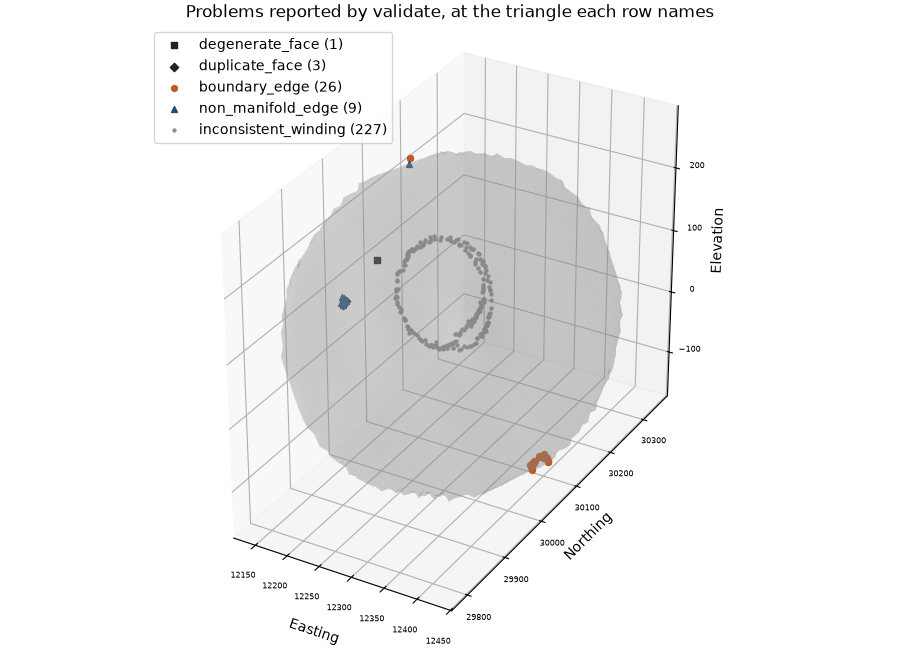
Five defects give 266 rows. The edges of the repeated triangles become non-manifold, each now held by three or more triangles. The fin adds a non-manifold edge where it meets the lens and two boundary edges along its free sides. The flipped patch shows only along its rim, where flipped and unflipped triangles meet.
Step 2: Locate the problems
Each row's face gives a place: the center of that triangle. Plotted on the lens by kind, the rows fall into
the five places the damage went in.
face_centers = broken.coords[broken.triangles].mean(axis=1)
styles = {
    "degenerate_face": ("s", INK),
    "duplicate_face": ("D", INK),
    "boundary_edge": ("o", HIGHLIGHT),
    "non_manifold_edge": ("^", ACCENT),
    "inconsistent_winding": (".", GRAY),
}
fig = plt.figure(figsize=(9, 6.5), layout="constrained")
ax = fig.add_subplot(projection="3d")
ax.plot_trisurf(*vertices.T, triangles=triangles, color=LIGHT, linewidth=0, alpha=0.25)
for kind, (marker, color) in styles.items():
    faces = problems.filter(problems["kind"] == kind)["face"].to_numpy()
    xyz = face_centers[faces]
    ax.scatter(*xyz.T, marker=marker, color=color, s=18, depthshade=False, label=f"{kind} ({len(faces)})")
ax.set_box_aspect(high - low)
ax.set(xlabel="Easting", ylabel="Northing", zlabel="Elevation")
ax.tick_params(labelsize=6)
ax.legend(loc="upper left")
ax.set_title("Problems reported by validate, at the triangle each row names")
save(fig, "problems")
Step 3: Repair what can be repaired automatically
repair drops degenerate and repeated triangles and rewinds each connected piece consistently, outward for
a closed piece. With tolerance it also welds vertices closer than that distance, which fixes a solid read as
loose triangles (mesh files). It does not delete
triangles that belong to the surface or invent new ones, so the fin and the hole stay.
repaired = broken.repair()
report = repaired.validate()
print(repaired)
print({k: v for k, v in report.summary.items() if v})
Out:
Mesh(12955 vertices, 25883 triangles, open, 26 boundary edges)
{'boundary_edges': 26, 'non_manifold_edges': 1, 'shells': 1}
Step 4: Fix the rest by hand
The one non-manifold edge left is where the fin meets the lens. Of the three triangles on that edge, the fin is the one that also has boundary edges; deleting it and repairing again drops its unused tip vertex. The boundary edges left then run around the hole. Fanning a triangle from each of them to the mean of their corners closes it. Each new triangle runs its boundary edge in the opposite direction to the triangle across it, so the winding stays consistent.
problems = report.problems.to_polars()
tri = repaired.triangles
edge = problems.filter(problems["kind"] == "non_manifold_edge").row(0, named=True)
a, b = tri[edge["face"], edge["edge"]], tri[edge["face"], (edge["edge"] + 1) % 3]
on_edge = np.flatnonzero(np.isin(tri, [a, b]).sum(axis=1) == 2)
open_faces = problems.filter(problems["kind"] == "boundary_edge")["face"].to_numpy()
fin = np.intersect1d(on_edge, open_faces)
print(f"triangles on the non-manifold edge {on_edge}, fin {fin}")
without_fin = bt.Mesh(repaired.coords, np.delete(tri, fin, axis=0)).repair()

rim = without_fin.validate().problems.to_polars()
rim = rim.filter(rim["kind"] == "boundary_edge")
tri = without_fin.triangles
start = tri[rim["face"].to_numpy(), rim["edge"].to_numpy()]
end = tri[rim["face"].to_numpy(), (rim["edge"].to_numpy() + 1) % 3]
patch_center = len(without_fin.coords)
cap = np.column_stack([end, start, np.full(len(start), patch_center)])
fixed = bt.Mesh(
    np.vstack([without_fin.coords, without_fin.coords[start].mean(axis=0)]), np.vstack([tri, cap])
)
print(f"hole rim: {len(rim)} edges, closed with {len(cap)} triangles")
print(fixed, fixed.validate())
Out:
triangles on the non-manifold edge [13904 13905 25882], fin [25882]
hole rim: 24 edges, closed with 24 triangles
Mesh(12955 vertices, 25906 triangles, closed) MeshReport(0 problems, 1 shells, closed)
Check before you move on
The fixed solid has no problems left. Its volume differs from the original by the difference between the flat fan and the curved surface the hole removed, and the inside test agrees with the original's on all but the points in that sliver.
assert fixed.validate().summary["is_closed"]
print(
    f"volume {fixed.volume:,.0f} m3, original {lens.volume:,.0f} m3 ({fixed.volume / lens.volume - 1:+.3%})"
)
disagree = fixed.contains(points) != truth
print(f"inside test: {disagree.sum()} of {len(points):,} points disagree with the original")
Out:
volume 1,900,886 m3, original 1,901,081 m3 (-0.010%)
inside test: 0 of 20,000 points disagree with the original
The decision
Validate every solid before using it, and read every count in the summary, inconsistent_edges and inward_shells included. Let repair handle
duplicates, slivers and winding; delete fins and close holes by hand, then validate again until the report is
empty. When a hole is larger than a few triangles, a flat fan no longer follows the surface: go back to whoever
built the solid instead.
See also
- Solids: inside tests and block proportions on valid solids.
- Mesh files: reading, writing and welding loose triangles.
- Flag solid proportions in a block model: what a valid solid is for.
Total running time of the script: ( 0 minutes 2.097 seconds)
Download Python source code: example_14_03.py