Note
Click here to download the full example code
Sub-block a model from solids
The previous tutorial kept vein proportions on 5 m blocks. Many models instead need one domain per cell, for example to estimate grade inside each vein with its own samples. With 10 m parent blocks and veins one to two meters thick, a label per parent block puts most of the vein volume in the wrong place. Sub-blocking splits the parents a vein surface crosses into smaller cells, so the labels follow the contacts. You compare the volume the parents capture and the volume sub-blocks of several sizes capture with the volume of the solids.
import sys
from pathlib import Path

HERE = Path(__file__).parent if "__file__" in globals() else Path.cwd()
sys.path.insert(0, str(HERE.parents[1]))
import boitata as bt
import matplotlib.pyplot as plt
import numpy as np
from common import ACCENT, GRAY, HIGHLIGHT, save
What you'll learn
- How
BlockModel.subblocksplits parent blocks along solid contacts. - Why a total volume close to the solid's can hide volume in the wrong place, and how to measure it.
- How to choose the sub-grid from the thickness of the solids.
Prerequisites: flag solid proportions in a block model and
sub-blocks, which introduces subblock,
from_meshes and regularize on the stacked lenses.
The data
The four veins of the vein-gold grade-control dataset and a parent grid of 10 m blocks around them.
data = bt.datasets.vein_gold_grade_control()
names = ["V1", "V2", "V3", "V4"]
veins = [data[f"vein_{name}"] for name in names]
parents = bt.BlockModel.from_extents(*veins, size=(10, 10, 10), buffer=10, snap=True)
solid_volume = sum(vein.volume for vein in veins)
print(parents)
print(f"veins: {solid_volume:,.0f} m3")
Out:
BlockModel(regular, 140352 of 140352 cells, count [32, 86, 51], size [10.0, 10.0, 10.0], rotation [0.0, 0.0, 0.0])
veins: 1,035,991 m3
Step 1: Sub-block against the solids
subblock takes (mesh, "inside", label) domains in priority order and n, the sub-cells per parent edge.
Every parent a vein surface crosses is split into n × n × n sub-cells; each sub-cell takes the label of the
first domain holding its center, and neighboring sub-cells with one label merge into larger sub-blocks.
Parents no surface crosses stay whole. Listing V4 last gives the space it shares with the other veins to
them, the same priority as in the previous tutorial. With n = 1 there is no splitting: each parent takes
the label at its center.
domains = [(vein, "inside", name) for vein, name in zip(veins, names)]
models = {n: parents.subblock(domains, n) for n in (1, 2, 4, 8, 16)}
for n, model in models.items():
    print(f"n = {n:<2}: {len(model):>7,} blocks, smallest {model.volumes.min():g} m3")
Out:
n = 1 :   1,046 blocks, smallest 1000 m3
n = 2 :   6,397 blocks, smallest 125 m3
n = 4 :  33,031 blocks, smallest 15.625 m3
n = 8 : 152,906 blocks, smallest 1.95312 m3
n = 16: 679,610 blocks, smallest 0.244141 m3
Step 2: Measure captured and misplaced volume
The volume labeled as a vein can match the solid while sitting in the wrong place: a block labeled V1 that is
mostly outside V1 is offset by vein volume in blocks left unlabeled. The misplaced volume adds the two:
labeled volume outside the vein, plus vein volume outside its labeled blocks. Mesh.proportion on the
labeled blocks measures both.
def volumes(model):
    labels = model["domain"]
    captured = misplaced = 0.0
    for vein, name in zip(veins, names):
        part = model.filter(labels == name)
        inside = (vein.proportion(part) * part.volumes).sum()
        captured += part.volumes.sum()
        misplaced += part.volumes.sum() - inside + vein.volume - inside
    return captured, misplaced


print(f"{'':7}{'labeled (m3)':>14}{'vs solids':>11}{'misplaced (m3)':>16}{'share':>7}")
for n, model in models.items():
    captured, misplaced = volumes(model)
    print(
        f"n = {n:<2}{captured:14,.0f}{captured / solid_volume - 1:+11.1%}{misplaced:16,.0f}"
        f"{misplaced / solid_volume:7.0%}"
    )
Out:
         labeled (m3)  vs solids  misplaced (m3)  share
n = 1      1,046,000      +1.0%       1,625,804   157%
n = 2      1,038,125      +0.2%       1,222,097   118%
n = 4      1,033,672      -0.2%         776,380    75%
n = 8      1,033,709      -0.2%         412,907    40%
n = 16     1,033,922      -0.2%         172,732    17%
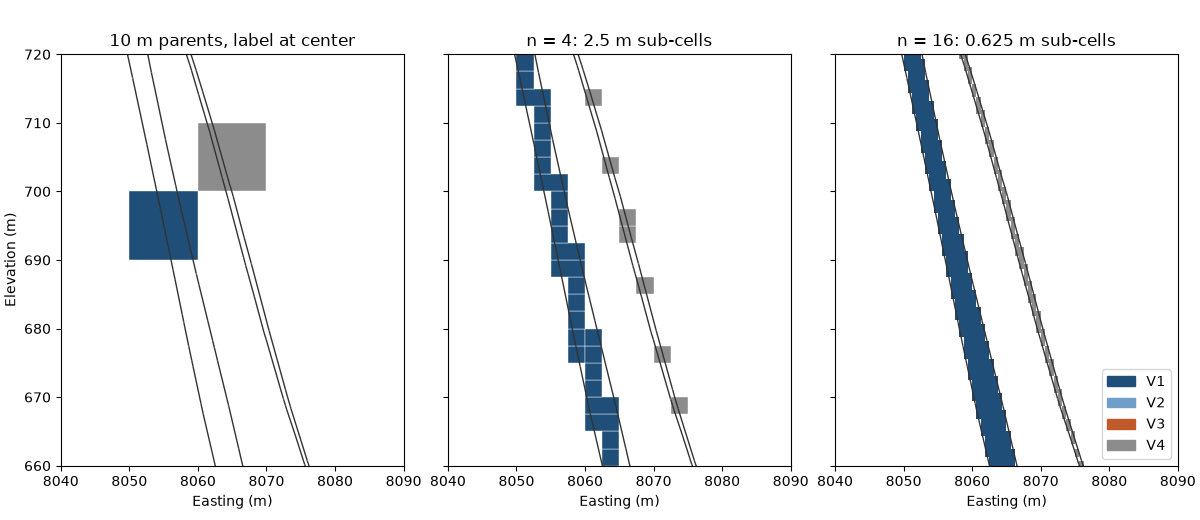
Every sub-grid labels within about 1 % of the solids' total volume, the whole parents included. The misplaced volume
tells them apart. Labeled at their centers, 10 m parents misplace 157 % of the vein volume: more than the veins
hold. Each halving of the sub-cell cuts the misplaced volume, to 40 % at n = 8 (1.25 m sub-cells) and 17 % at
n = 16 (0.625 m). What remains is the sliver along each contact thinner than a sub-cell, and a vein 1 m thick
is mostly such slivers.
Pitfall
A total that matches the solid does not show that the labels sit in the right place. Centered labels err on both sides of a contact, and the errors cancel in the total. Measure the misplaced volume, or compare a section with the solid outlines.
Step 3: Look at a section
A vertical east–west section across V1 and V4 at northing 15 000.3 m, with the vein outlines. The northing falls between sub-cell faces, so the section cuts each cell once.
plane = ((0, 15000.3, 0), 90, 90)
scheme = bt.Categories(names, colors=[ACCENT, "#6f9fc9", HIGHLIGHT, GRAY])
fig, axes = plt.subplots(1, 3, figsize=(12, 5.2), sharey=True, layout="constrained")
for ax, n in zip(axes, (1, 4, 16)):
    model = models[n]
    codes = scheme.encode(model["domain"])
    edges = {"edgecolor": "white", "linewidths": 0.3 if n < 16 else 0}
    bt.plot.section(model, codes, plane=plane, scheme=scheme, colorbar=False, ax=ax, **edges)
    bt.plot.slab(np.empty((0, 3)), plane=plane, thickness=1, meshes=veins, ax=ax)
    title = "10 m parents, label at center" if n == 1 else f"n = {n}: {10 / n:g} m sub-cells"
    ax.set(title=title, xlim=(8040, 8090), ylim=(660, 720))
    if ax is not axes[0]:
        ax.set_ylabel("")
bt.plot.category_legend(scheme, ax=axes[2], loc="lower right")
save(fig, "section")
Check before you move on
Sub-blocks must tile their parents: no parent holds more sub-block volume than its own. Each vein's
labeled volume at n = 16 should match its solid to within a percent.
fine = models[16]
per_parent = np.bincount(fine.index.astype(np.int64), weights=fine.volumes)
print(f"largest volume in one parent: {per_parent.max():g} m3 of {np.prod(parents.size):g} m3")
assert per_parent.max() <= np.prod(parents.size) + 1e-6
labels = fine["domain"]
for vein, name in zip(veins, names):
    labeled = fine.volumes[labels == name].sum()
    print(
        f"{name}: sub-blocks {labeled:9,.0f} m3, solid {vein.volume:9,.0f} m3 ({labeled / vein.volume - 1:+.2%})"
    )
Out:
largest volume in one parent: 648.438 m3 of 1000 m3
V1: sub-blocks   658,560 m3, solid   658,570 m3 (-0.00%)
V2: sub-blocks   142,107 m3, solid   142,085 m3 (+0.02%)
V3: sub-blocks   179,841 m3, solid   179,815 m3 (+0.01%)
V4: sub-blocks    53,415 m3, solid    55,521 m3 (-3.79%)
The largest parent holds 648 m³ of vein sub-blocks, under its 1000 m³. V1 to V3 match their solids to within 0.02 %. V4 falls 3.79 % short, the space it gave to the veins it crosses, as in the previous tutorial.
The decision
Size the sub-cell from the thinnest solid. The veins are 0.7 to 2 m thick, so n = 16 gives 0.625 m sub-cells,
about half the thickness of V2 and V3. It needs 679,610 blocks against 152,906 at n = 8, and it misplaces 17 %
of the vein volume against 40 %. The labels then follow the contacts close enough to select samples and
estimate each vein apart. For tonnage, also store each sub-block's proportion inside its vein, as in the
previous tutorial, so the volume balances without the slivers.
See also
- Sub-blocks:
from_meshes, surfaces as domains andregularizeback to parents. - Find and fix degenerate solids: the solids must be valid before any of this.
Total running time of the script: ( 0 minutes 5.933 seconds)
Download Python source code: example_14_02.py