Note
Click here to download the full example code
solids
a closed triangle mesh bounds a domain. Mesh.contains flags the samples inside it, Mesh.proportion measures
how much of each block it fills, BlockModel.mask keeps the blocks that count as inside and block_shell draws
them. here the three stacked sulphide lenses are the solids.
import sys
from pathlib import Path

HERE = Path(__file__).parent if "__file__" in globals() else Path.cwd()
sys.path.insert(0, str(HERE.parents[1]))
import boitata as bt
import matplotlib.pyplot as plt
import numpy as np
from common import ACCENT, GRAY, HIGHLIGHT, LIGHT, save
from mpl_toolkits.mplot3d.art3d import Poly3DCollection
a solid needs a closed mesh: no boundary edges, each edge shared by two triangles. run Mesh.validate before you
rely on an inside. mesh files repairs meshes that fail it.
data = bt.datasets.stacked_sulphide_lenses()
lenses = [data[f"lens_{i}"] for i in (1, 2, 3)]
for i, lens in enumerate(lenses, 1):
    print(
        f"lens {i}: {lens}, {lens.validate().summary['boundary_edges']} boundary edges, {lens.volume:,.0f} m3"
    )
Out:
lens 1: Mesh(15766 vertices, 31528 triangles, closed), 0 boundary edges, 2,788,266 m3
lens 2: Mesh(12962 vertices, 25920 triangles, closed), 0 boundary edges, 1,901,081 m3
lens 3: Mesh(13034 vertices, 26064 triangles, closed), 0 boundary edges, 1,652,929 m3
contains tests points by generalized winding number. of the 2 m zinc composites, those inside a lens carry
the ore:
holes = bt.Drillholes.from_tables(data)
composites = holes.composite(2.0, ["ZN_PCT"])
xyz, zn = composites.coords, composites["ZN_PCT"]
inside = np.array([lens.contains(xyz) for lens in lenses])
for i, flags in enumerate(inside, 1):
    print(f"lens {i}: {flags.sum():4} composites, mean Zn {np.nanmean(zn[flags]):.2f}%")
outside = ~inside.any(axis=0)
print(f"outside: {outside.sum()} composites, mean Zn {np.nanmean(zn[outside]):.2f}%")
Out:
lens 1:  603 composites, mean Zn 6.19%
lens 2:  280 composites, mean Zn 5.97%
lens 3:  252 composites, mean Zn 6.02%
outside: 12177 composites, mean Zn 0.08%
BlockModel.from_extents builds a 20 × 20 × 10 m model around the lenses (block model from extents). proportion settles
blocks that no triangle passes through with one centroid test and samples discretization³ points in the others,
here 8. summed over the blocks, the proportions give back each lens's volume to within 1 %.
size = (20, 20, 10)
blocks = bt.BlockModel.from_extents(*lenses, size=size, buffer=10, snap=True)
proportions = [lens.proportion(blocks, discretization=2) for lens in lenses]
for i, (lens, p) in enumerate(zip(lenses, proportions), 1):
    print(f"lens {i}: mesh {lens.volume:,.0f} m3, blocks {p.sum() * np.prod(size):,.0f} m3")
blocks = blocks.with_column("proportion", np.sum(proportions, axis=0))
Out:
lens 1: mesh 2,788,266 m3, blocks 2,788,500 m3
lens 2: mesh 1,901,081 m3, blocks 1,884,000 m3
lens 3: mesh 1,652,929 m3, blocks 1,652,500 m3
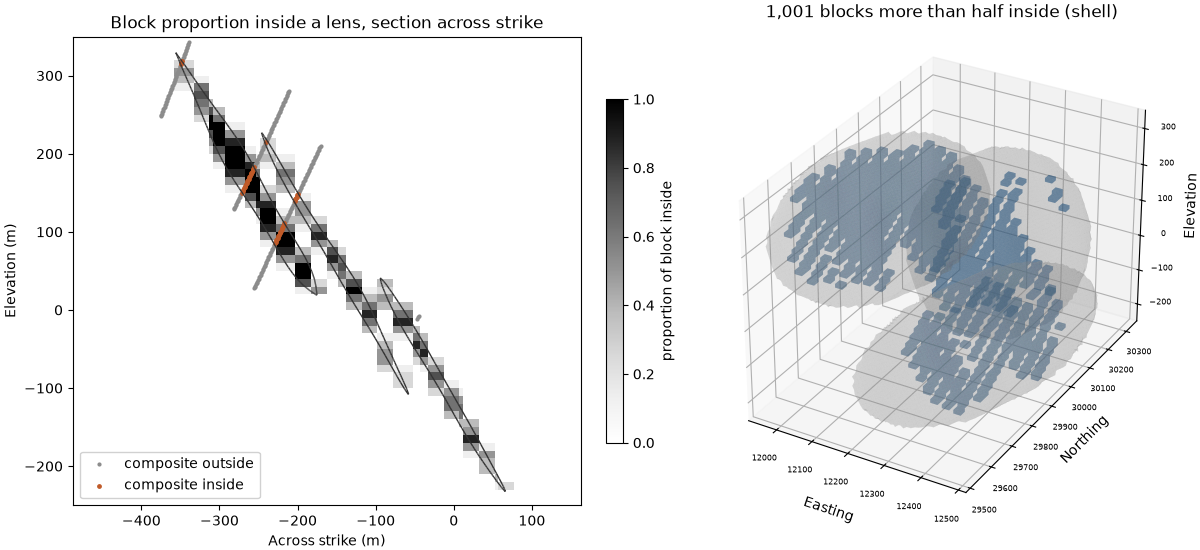
mask keeps the blocks more than half inside a lens. the lenses are thin next to the blocks, so many blocks
they cross are less than half filled, and the kept blocks hold under two thirds of the lens volume. sub-blocks
sub-blocks the edges instead.
ore = blocks.filter(blocks["proportion"] > 0.5)
print(f"{len(blocks):,} blocks, {len(ore):,} more than half inside: {ore.volumes.sum():,.0f} m3")
print(f"lenses: {sum(lens.volume for lens in lenses):,.0f} m3")
Out:
79,200 blocks, 1,001 more than half inside: 4,004,000 m3
lenses: 6,342,276 m3
a vertical section across strike (the lenses strike N22.5°E) shows the block proportions with the lens
outlines and the composites within 10 m of the section. block_shell turns the masked blocks into the mesh of
their outer faces, drawn in 3D over the lens surfaces.
center = np.mean([lens.coords.mean(axis=0) for lens in lenses], axis=0)
plane = (center, 112.5, 90)
fig = plt.figure(figsize=(12, 5.5), layout="constrained")
a = fig.add_subplot(1, 2, 1)
bt.plot.section(blocks, "proportion", plane=plane, colorbar=False, vmin=0, vmax=1, cmap="Greys", ax=a)
bt.plot.slab(xyz[outside], plane=plane, thickness=20, s=4, color=GRAY, label="composite outside", ax=a)
bt.plot.slab(
    xyz[~outside],
    plane=plane,
    thickness=20,
    meshes=lenses,
    s=6,
    color=HIGHLIGHT,
    label="composite inside",
    ax=a,
)
a.set(title="Block proportion inside a lens, section across strike", xlabel="Across strike (m)")
a.legend(loc="lower left", frameon=True, framealpha=0.9)
fig.colorbar(a.images[0], ax=a, shrink=0.7, label="proportion of block inside")

b = fig.add_subplot(1, 2, 2, projection="3d")
shell = bt.block_shell(ore)
b.add_collection3d(
    Poly3DCollection(shell.coords[shell.triangles], facecolor=ACCENT, edgecolor="none", alpha=0.35)
)
for lens in lenses:
    b.plot_trisurf(*lens.coords.T, triangles=lens.triangles, color=LIGHT, linewidth=0, alpha=0.2)
lo, hi = map(np.array, blocks.bounds)
b.set(xlim=(lo[0], hi[0]), ylim=(lo[1], hi[1]), zlim=(lo[2], hi[2]))
b.set_box_aspect(hi - lo)
b.set_title(f"{len(ore):,} blocks more than half inside (shell)")
b.set_xlabel("Easting")
b.set_ylabel("Northing")
b.set_zlabel("Elevation")
b.tick_params(labelsize=6)
save(fig, "solids")
Total running time of the script: ( 0 minutes 1.072 seconds)
Download Python source code: example_02_05.py