Note
Click here to download the full example code
high-grade restriction
a rich sample informs every node its search reaches, so an isolated high value spreads its grade far beyond the ground
it represents. bt.HighGrade restricts samples above a threshold beyond a distance: mode="drop" leaves them out,
mode="clamp" keeps them at the threshold, and ranges with a rotation give the restriction its own ellipse. each search
pass carries its own restriction. the example block-kriges walker lake V in 5 m blocks and checks it against the
exhaustive block averages.
import sys
from pathlib import Path

HERE = Path(__file__).parent if "__file__" in globals() else Path.cwd()
sys.path.insert(0, str(HERE.parents[1]))
import boitata as bt
import matplotlib.pyplot as plt
import numpy as np
from common import ACCENT, GRAY, HIGHLIGHT, INK, LIGHT, save

samples = bt.datasets.walker_lake()
xy, v = samples.coords[:, :2], samples["V"]
exhaustive = bt.datasets.walker_lake_exhaustive()["V"].reshape(300, 260)
grid = bt.BlockModel(origin=(0.5, 0.5), size=(5, 5), count=(52, 60))
truth = exhaustive.reshape(60, 5, 52, 5).mean(axis=(1, 3)).ravel()

azimuths = np.arange(0, 180, 22.5)
directional = [bt.experimental_variogram(samples, "V", 10.0, 120.0, azimuth=a) for a in azimuths]
model = bt.Variogram.fit_directional(
    directional, [(a, 0) for a in azimuths], ["spherical", "spherical"], weighting="count/gamma"
)
kriging = bt.BlockKriging(model, bt.Search(radius=80), (5, 5)).fit(samples, "V")


def search(high_grade=None, *, radius=80, min_samples=4):
    ellipse = {"rotation": model.rotation, "ratios": (0.5, 1.0)}
    return bt.Search(
        radius=radius, max_samples=24, min_samples=min_samples, octant=True, high_grade=high_grade, **ellipse
    )
four restrictions
the threshold is 600 ppm, reached by almost a third of the samples, and the restricted distance is 20 m. the tuple
(600, 20) is shorthand for bt.HighGrade(600, 20), which drops. clamp keeps the far rich samples at 600 ppm, so
they still pull the node up, by less. the ellipse restricts to 40 m along the continuity and 10 m across it. the
passes restrict to 15 m in a tight first pass and to 30 m in the wide second, compared with the same passes
unrestricted.
blocks 20 to 50 m from the nearest rich sample form its halo: beyond the restricted distance, within the search. there an unrestricted estimate spreads rich values, and there the restriction acts.
threshold = 600
rich = xy[v > threshold]
nearest = np.sqrt(((grid.coords[:, None, :2] - rich[None]) ** 2).sum(-1)).min(axis=1)
halo = (nearest > 20) & (nearest < 50)

searches = {
    "none": search(),
    "drop": search((threshold, 20)),
    "clamp": search(bt.HighGrade(threshold, 20, mode="clamp")),
    "ellipse": search(bt.HighGrade(threshold, (40, 10, 10), rotation=model.rotation)),
    "passes, none": [search(radius=30, min_samples=8), search()],
    "passes": [search((threshold, 15), radius=30, min_samples=8), search((threshold, 30))],
}
cutoffs = np.arange(100, 801, 50)
estimates, metal = {}, {}
print(f"{np.mean(v > threshold):.0%} of the samples above {threshold} ppm, {halo.sum()} halo blocks")
print(f"{'search':>13}  halo mean error  block RMSE  metal above 300 ppm  cross-validation mean error")
for name, s in searches.items():
    estimator = kriging.with_search(s)
    estimate = estimates[name] = estimator.predict(grid)
    metal[name] = [estimate[estimate > c].sum() / truth[truth > c].sum() for c in cutoffs]
    print(
        f"{name:>13}  {np.mean(estimate[halo] - truth[halo]):+10.1f} ppm  {bt.compare(estimate, truth)['rmse']:7.1f}"
        f"  {metal[name][4]:14.1%}  {estimator.cross_validate().mean_error:+18.1f} ppm"
    )
Out:
31% of the samples above 600 ppm, 1542 halo blocks
       search  halo mean error  block RMSE  metal above 300 ppm  cross-validation mean error
         none       +15.6 ppm    117.9           96.8%               +10.3 ppm
         drop       +10.5 ppm    117.1           94.2%                +9.0 ppm
        clamp       +13.9 ppm    117.5           96.1%               +12.5 ppm
      ellipse       +11.6 ppm    117.3           94.2%                +7.3 ppm
 passes, none       +15.8 ppm    118.4           98.0%               +14.0 ppm
       passes       +11.4 ppm    116.8           94.1%                +9.0 ppm
unrestricted, the halo blocks are overestimated by 16 ppm on average. dropping the rich samples beyond 20 m takes a third of that off, and clamp lands between the two, as it must: a far rich sample enters at 600 ppm instead of at its grade or not at all. the ellipse, which lets rich samples reach twice as far along the continuity, does almost as well as the circle. the restricted passes correct as much as the single restricted search.
metal above cutoff
metal above a cutoff is the sum of the block grades above it, here relative to the exhaustive truth.
fig, (a, b) = plt.subplots(1, 2, figsize=(8.8, 3.6), layout="constrained")
styles = {"none": (GRAY, "-"), "drop": (ACCENT, "-"), "clamp": (HIGHLIGHT, "-"), "ellipse": (ACCENT, ":")}
for name, (color, ls) in styles.items():
    a.plot(cutoffs, metal[name], color=color, ls=ls, lw=1.5, label=name)
a.axhline(1, color=INK, lw=0.8)
a.set(xlabel="Cutoff (ppm)", ylabel="Estimated / true metal", title="Metal above cutoff")
a.legend(loc="lower left")

names = list(searches)
errors = [np.mean(estimates[n][halo] - truth[halo]) for n in names]
colors = [GRAY if n.endswith("none") else ACCENT for n in names]
b.barh(names, errors, color=colors)
for y, e in enumerate(errors):
    b.text(e + 0.3, y, f"{e:+.1f}", va="center", color=INK)
b.axvline(0, color=INK, lw=0.8)
b.invert_yaxis()
b.set(xlabel="Mean error (ppm)", title="Halo blocks, 20 to 50 m from a rich sample")
b.spines["left"].set_color(LIGHT)
save(fig, "modes")
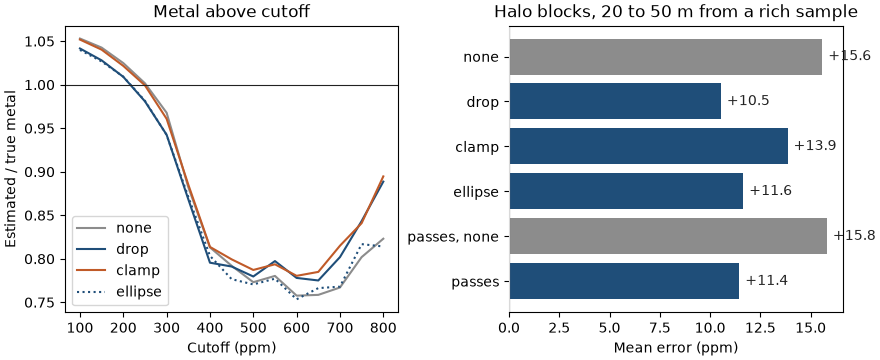
at low cutoffs the unrestricted estimate puts a little too much metal, and dropping brings it closest to the truth. from 400 ppm up every estimate falls about a fifth short: that is the smoothing of kriging, which no restriction cures. above 650 ppm the restriction even adds metal. inside dense clusters of rich samples, ordinary kriging gives the screened far ones small negative weights (search). dropping a negative weight on a high value raises the estimate, and clamping, which swaps it for a negative weight on the lower threshold, raises it too.
the cross-validation mean error follows little of this: the samples sit in the clusters, where the restriction acts through those negative weights, and not in the halos. judge a restriction against the truth, or a simulated one.
Total running time of the script: ( 0 minutes 0.388 seconds)
Download Python source code: example_06_08.py